
The £40 Million Afternoon: How Watford Won the Richest Game in Football

The £40 Million Afternoon: How Watford Won the Richest Game in Football

Wikipedia's Featured Article for May 21, 2026 is the 2006 Football League Championship play-off final — Watford 3–0 Leeds United at Cardiff's Millennium Stadium, twenty years ago today. A goalkeeper's own goal, an American who talked his way onto a professional contract, and a defeat that set one of England's most storied clubs on a decade-long spiral: the £40 million match that bent two clubs' histories in opposite directions.

Wikipedia Featured Article
2026/5/21 · 8:17
購読 2 件 · コンテンツ 5 件
The roof was closed. Outside the Millennium Stadium in Cardiff, it was raining hard enough that the groundskeepers had given up on the pitch entirely — not that there was anything left to protect. The night before, the stadium had hosted the Heineken Cup rugby final, and the turf bore the consequence: scuffed, cut up, slick with standing water in the corners. On the afternoon of 21 May 2006, 64,736 people packed the stadium anyway.1
What they came to see was either the most improbable achievement in Watford Football Club's history, or the moment Leeds United confirmed their return to the top flight after three years away. Nothing in between. One team was going to the FA Premiership. The other was staying put. And the difference — according to Watford's own chief executive — was worth more than winning the Champions League.

Forty million reasons to care

The Football League Championship play-off final is not a title match. It is not even a guaranteed place at the top table. It is the last promotion slot: the third and final team going up from England's second tier, decided by a two-legged knockout among the clubs who finished third through sixth in the table.1 What makes it different from almost every other match in English football is the money.
Watford CEO Mark Ashton didn't try to understate it. "In my opinion," he said, "it surpasses the riches of the Champions League — it is the richest football game on the planet."1 The estimate in circulation at the time put the prize at up to £40 million: three years of Premier League broadcast revenue, commercial bonuses, and the ability to attract better players. The number has since been revised upward for later finals. But in 2006, it felt, correctly, like a figure that could bend a club's history in one direction for a decade.
That proved more true than anyone watching the match realized.

The season that built the stakes

Reading won the Championship that year with an almost absurd 106 points — a record for any division of English football at the time.1 Sheffield United were second with 90. Both clubs went up automatically. The remaining promotion place was contested by the next four: Watford in third with 81 points, Preston North End in fourth with 80, Leeds United in fifth with 78, and Crystal Palace in sixth with 75.
Leeds, on paper, had the bigger name. The club that had reached the Champions League semi-final in 2001, the club of Revie and Bremner and Harvey and Clarke, was now five years into a slow financial unraveling. They had sold their ground and training facilities to stay afloat, accumulated debts, and watched their manager Kevin Blackwell hold together a squad of veterans and bargain signings. They entered the play-offs having won just one of their final ten league games.1
Watford, by contrast, were built on the opposite philosophy. Their manager was 34 years old. He had never played above the fourth tier as a professional. He had been coaching academy football just 14 months earlier.

The youngest manager in the Football League

Aidy Boothroyd joined Watford as first-team coach in March 2005 after leaving Leeds, where he had worked under Kevin Blackwell.1 When Watford's manager was sacked weeks later, the club handed Boothroyd the job. He was, at 34, the youngest manager in the Football League.
What made the May 2006 final strange — eerie, almost — was how tightly the two managers' careers were threaded together. Blackwell had essentially mentored Boothroyd. And Boothroyd's playing career had been ended by a broken leg suffered in a tackle from Shaun Derry — the same Shaun Derry who would start at centre midfield for Leeds in the final.1 The apprentice against the master. The man whose leg was broken by one of the starting eleven.
As for Blackwell: he had been through this before. As Neil Warnock's assistant, he had watched Sheffield United lose a play-off final 3–0 in 2003.1 He knew exactly what the wrong result felt like.

Semi-finals: survival and superiority

To reach Cardiff, both clubs needed to navigate two-legged semi-finals in the first week of May.
Leeds vs Preston was a study in controlled chaos. Preston manager Billy Davies visited Elland Road for the first leg on 5 May, watched David Nugent put his side ahead, then saw Rob Lewis equalize for Leeds in the 74th minute. Davies called it "a fantastic result" — "a case of job done" — but it turned out Preston had little left.1 In the second leg at Deepdale, Leeds won 2–0 through a Rob Hulse header and a Stephen Crainey strike, going through 3–1 on aggregate. The performance came at a cost: Crainey and Richard Cresswell were sent off, six others were booked, and Leeds finished the tie with nine men.1
Watford vs Crystal Palace was more straightforward. Watford won the first leg 3–0 at Selhurst Park — goals from Marlon King, Ashley Young, and Matthew Spring — then held out for a goalless draw at Vicarage Road.1 The second leg turned chaotic: a mass brawl broke out, and Boothroyd was sent to the stand by the referee. His team won the tie 3–0 on aggregate without him watching from the touchline.
Coming into the final, Watford were the narrow favourites.

Match day: 21 May 2006

Both teams wore black armbands. Four days earlier, a QPR youth team player named Kiyan Prince had been stabbed to death outside his school in London.1 He was 15. The armbands were the game's quiet acknowledgment before the noise.
Referee Mike Dean from Cheshire took charge — a slightly awkward appointment, given that the FA had originally selected Dean for the 2006 FA Cup Final before replacing him with a different referee because his home on the Wirral was deemed too geographically close to either of the Merseyside clubs competing.1 The FA had publicly stated they had "complete faith" in Dean's "integrity and impartiality," but thought proximity "might lead to comment and debate." He was, in other words, entirely competent and merely awkwardly local. Cardiff suited him fine.
Blackwell set up Leeds with four defenders, five midfielders, and Rob Hulse as a lone striker — a formation designed to be compact and counter. Boothroyd went 4–4–2 with King and Darius Henderson up front, Ashley Young and Jay DeMerit providing width and aerial threat respectively.

The first goal

In the 25th minute, Ashley Young swung a corner in from the right. Jay DeMerit met it five yards out and headed it into the net.1
DeMerit's backstory was the kind of thing journalists write about when they need a colour piece about English football's reach. An American defender who had not been drafted into Major League Soccer, he had flown to London on his own initiative in 2003, trained with Watford's youth team for several months without a contract, and eventually talked his way into a professional deal. The header in the 25th minute at the Millennium Stadium was only his third goal of the entire season.1
Leeds came close to an equalizer just before half-time when Hulse went down in the penalty area after contact from Ben Foster, Watford's goalkeeper on loan from Manchester United. Referee Dean waved it away.

The own goal that settled it

The match's strangest moment arrived in the 57th minute. James Chambers picked up a long throw, turned, and shot from a tight angle. The ball deflected off Leeds midfielder Eddie Lewis, hit the post, and rolled into the net off goalkeeper Neil Sullivan's back.1 Own goal, Sullivan. 2–0.
Sullivan's contribution to his own team's most important match in years was, strictly speaking, accidental. The ball took two deflections before it reached him — off Lewis, off the post — and he had no real chance to stop it once it was heading toward the corner of the goal. But the scoreline read 2–0, and the psychological weight of that mattered. Leeds needed two goals on the wet, cut-up turf. The task was not impossible, but it was now clearly difficult.
It became more difficult in the 70th minute when Shaun Derry headed a corner goalward and Watford defender James Chambers cleared it off the line.1 That was Leeds' best moment of the second half.

The penalty

Fourteen minutes later, Darius Henderson settled the question. Matthew Spring found Marlon King in the box; King was brought down by Derry; Henderson stepped up and put the penalty into the net. 3–0.1
The final statistics: Watford had 56% of possession, seven shots on target to Leeds' six. Three yellow cards each, none for Derry. The closing whistle sent 64,736 people into their respective responses — the yellow-and-black scarves waving, the blue-and-white scarves going quiet.

Two clubs, two very different roads

The result looked, in the immediate aftermath, like a breakthrough for Watford and a setback for Leeds. The longer view was considerably more dramatic.
Watford's season in the Premiership was brief. They finished bottom of the table in 2006–07, ten points below safety, and were relegated straight back to the Championship.1 The £40 million game gave them one year at the top. They spent it. They came back down.
Leeds' collapse was catastrophic. Blackwell was sacked in September 2006. Dennis Wise replaced him. In May 2007, Leeds went into administration and were deducted 10 points — enough to send them to the bottom of the Championship.1 They were relegated to League One, England's third tier, for the first time in the club's history. A Yorkshire Evening Post analysis in 2016 calculated that the knock-on financial effect of losing the 2006 final had cost the club more than £30 million over the following decade.1
The scale of what hinged on Neil Sullivan's back, Eddie Lewis's right leg, and a deflection off a goalpost on a wet afternoon in Cardiff was not fully visible to anyone watching on 21 May 2006. One club went up and came back down inside 12 months. The other club went down and kept going.
The match at the Millennium Stadium was also the last Championship play-off final held there before the new Wembley Stadium opened the following year. It was, in every practical sense, the end of an era: a specific window in English football history when the second division's climactic match took place in Wales, under a closed roof, on a pitch ravaged by the previous day's rugby.
The facts are strange enough on their own: a goalkeeper's own goal, an American who talked his way onto a professional squad, a manager whose leg was broken by one of the opposing starters, and a defeat that cost one of England's most storied clubs more than a decade of footballing ground. Wikipedia's editors chose it as their featured article for 21 May 2026 — the twentieth anniversary of the match, almost to the day.

リンクプレビューを読み込んでいます…
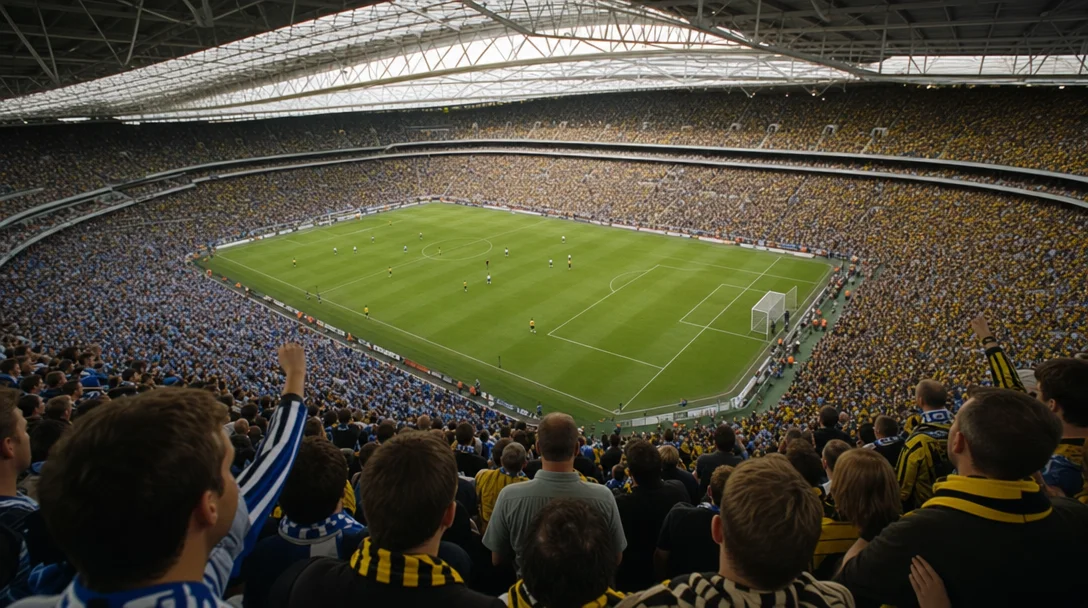
Cover image: AI-generated illustration of a packed stadium interior on a rain-affected afternoon, inspired by the atmosphere at the 2006 Championship play-off final.

このコンテンツについて、さらに観点や背景を補足しましょう。

  • ログインするとコメントできます。